
 Faculty of Science, Technology and Medicine
 Faculty of Law, Economics and Finance
 Faculty of Humanities, Education and Social Sciences
 Interdisciplinary Centre for Security, Reliability and Trust
 Luxembourg Centre for Systems Biomedicine
 Luxembourg Centre for Contemporary and Digital History
 Luxembourg Centre for European Law
 Luxembourg Centre for Socio-Environmental Systems
Specialty Training in Medicine
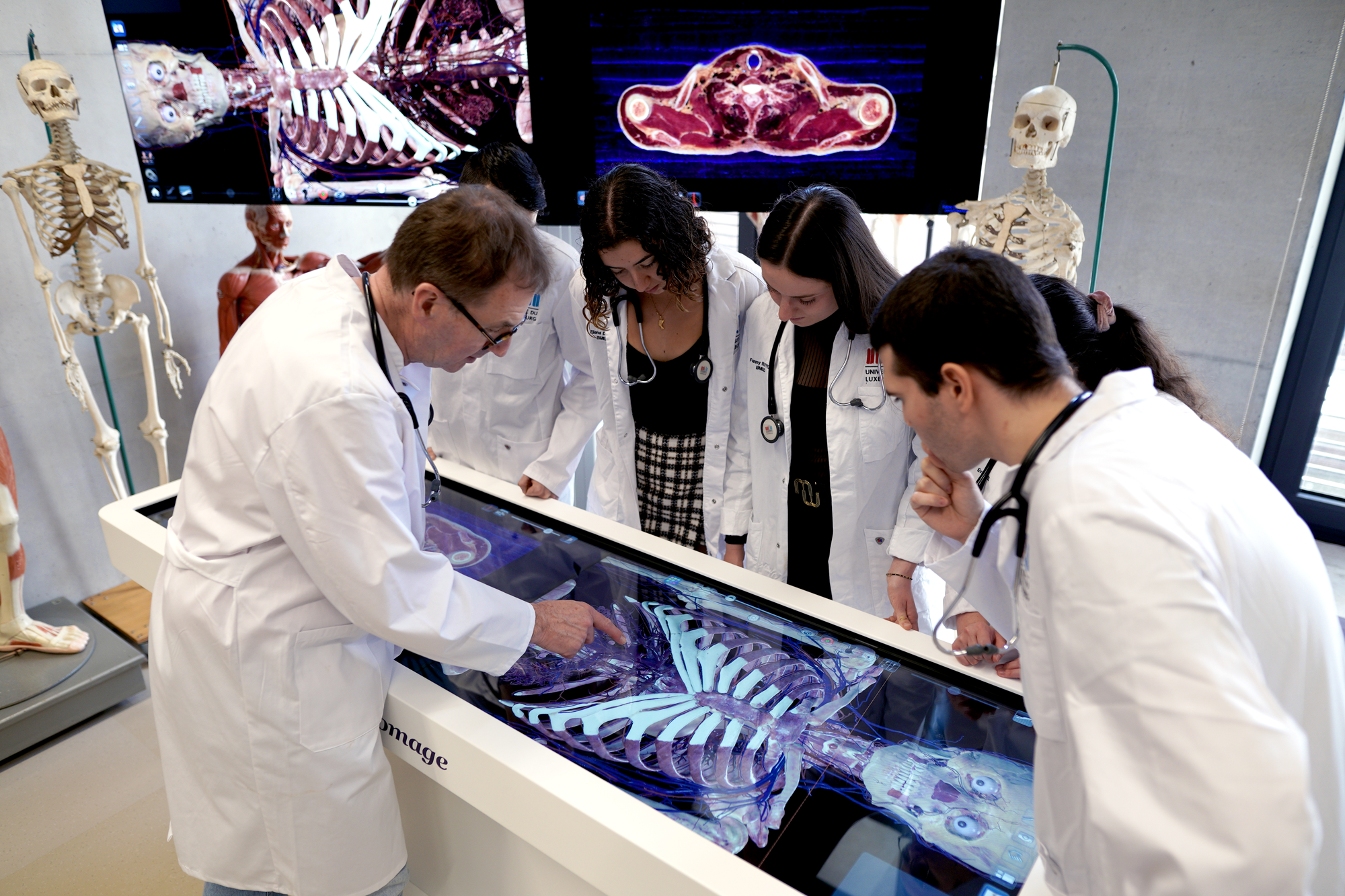
For applicants holding a Master’s degree in Medicine, the University of Luxembourg offers specialised training programmes. Learn how to apply.
The University of Luxembourg offers three advanced specialty training programmes in medicine, delivered by the Department of Health, Medicine and Life Sciences within the Faculty of Science, Technology and Medicine. These specialisations include General Medicine, Neurology and Medical Oncology. Specialised medical studies in General Medicine can lead either to a Master in General Medicine degree (Level 7) or to a Doctor in Medicine degree (Level 8 of the Luxembourg Qualifications Framework as defined in Article 69 of the Law of 28 October 2016 on the recognition of professional qualifications). Specialised medical studies in Neurology / Medical Oncology will lead to a Doctor in Medicine degree (Level 8 of the Luxembourg Qualifications Framework as defined in Article 69 of the Law of 28 October 2016 on the recognition of professional qualifications).
Ranking selection
Enrolment of any candidate is dependent on his/her personal situation. Criteria may differ depending on an applicant’s nationality, the origin of his/her diploma and his/her residence.
By default, all eligible applicants are subject to a ranking selection encompassing:
- A written test on general medical knowledge
- An oral interview on communication and cross-disciplinary skills
You are advised to carefully read the detailed information below corresponding to your profile.
European applicants
Any person who is a national of a Member State of the European Union (EU), of the European Economic Area (EEA) or of Switzerland is considered a European candidate.
-
Diploma
The applicant must have a basic medical education credential obtained in a Member State of the European Union (Switzerland, European Economic Area) referred to in Annex 5.1.1. of Directive 2005/36/EC or an equivalent diploma (cf. diploma obtained before the reference date set in Annex 5.1.1. or a “too recent” diploma not yet included in Annex 5.1.1.; In both cases, a certificate of conformity must be provided and established by the competent authority).
Pursuant to Art. 32 of the University Law, access to the studies leading to the advanced degree of DES in Medicine is open to applicants who meet the requirements of Article 1, paragraph 1, letters a), b), d) and e) of the amended law of 29 April 1983 on practising the professions of physician, dental physician and veterinary physician. For more information, please also see Section 10 of the 2020 Law on Specialisation.
All diplomas and/or transcripts must be translated by a sworn translator when issued in a language other than French, German or English.
-
European candidate with a basic medical training diploma (1st and 2nd cycle successfully completed)
If you are a European candidate with a diploma of basic medical training (first and second cycle successfully completed) issued by a higher education institution located in another Member State of the European Union, in a Member State of the European Economic Area or in the Swiss Confederation, your diploma is automatically recognized if it is listed in Annex 5.1.1. of Directive 2005/36/EC.
Candidates who have not yet completed their second cycle of studies in medicine at the time of submitting their application for admission may be offered conditional admission, in accordance with Article 34(3) of the Law, subject to providing all required documents, including authorization to practice temporarily, no later than November 15 of the year of enrollment.
Once you have received your diploma and transcript, you can upload these documents via your admission portal to complete your application. A definitive admission letter will be sent to you along with the invoice for the enrolment fee to finalise enrolment.
All admitted candidates must obtain a temporary authorization to practice issued by the Luxembourg Ministry of Health and Social Security. This authorization is required for the validation of final admission.
As long as this authorization has not been provided, students may attend theoretical courses but may not participate in internships. If the deadlines are not met, the admission is canceled.
-
European candidate with a university degree issued outside the European Union, the European Economic Area or Switzerland.
The applicant must have a basic medical education credential obtained in a third country that is recognised under the provisions of the Law of 28 October 2016 on the recognition of professional qualifications, more specifically meeting the criteria set out in Article 24 of this law.
Even if you have not yet received your diploma (or pass certificate) and/or it has not yet been recorded in the register of formal higher education qualifications by the application deadline for your chosen degree programme, you may still submit your application online In all cases, you must do so by the deadline set by the degree programme.
Candidates who have not yet completed their second cycle of studies in medicine at the time of submitting their application for admission may be offered conditional admission, in accordance with Article 34(3) of the Law, subject to providing all required documents, including authorization to practice temporarily, no later than November 15 of the year of enrollment.
Once you have received your diploma and transcript, you can upload these documents via your admission portal to complete your application. A definitive admission letter will be sent to you along with the invoice for the enrolment fee to finalise enrolment.
All admitted candidates must obtain a temporary authorization to practice issued by the Luxembourg Ministry of Health and Social Security. This authorization is required for the validation of final admission.
As long as this authorization has not been provided, students may attend theoretical courses but may not participate in internships. If the deadlines are not met, the admission is canceled.
Proof is now required of proficiency in the programme’s languages of instruction (attesting to French and German B2 and English B1) in accordance with the Common European Framework of Reference for Languages – CEFR.
Proof of language proficiency must be demonstrated in the following way:
The completion of a Master’s degree may exempt from providing a language certificate for one of the programme’s languages if the entire study programme was taken and assessed in one of the programme languages the student wishes to apply for, and if the degree was obtained less than two years before the application date.
To learn more about accepted test
It is possible to submit a request for recognition of prior learning (VAE) to have ECTS recognised.
Recognition (VAE) is based on:
- Education and/or at least 3 years of full-time equivalent work experience in the same field as the desired degree programme.
More specifically, recognition will be based on clinical internships performed and validated by accredited internship supervisors.
Recognition allows the student to be partially exempted from taking certain courses in the degree programme.
All requests for validation of prior learning and experience must be submitted via the dedicated form.
Please confirm the deadline of your desired specialty training programme on its webpage.
Third country national applicants
Any person with non-EU, non-EEA and non-Swiss nationality is considered a third-country national.
-
Diploma
The applicant must have a basic medical education credential obtained in a Member State of the European Union (Switzerland, European Economic Area) referred to in Annex 5.1.1. of Directive 2005/36/EC or an equivalent diploma (cf. diploma obtained before the reference date set in Annex 5.1.1. or a “too recent” diploma not yet included in Annex 5.1.1.; In both cases, a certificate of conformity must be provided and established by the competent authority); or a basic medical education credential obtained in a third country that is recognised under the provisions of the Law of 28 October 2016 on the recognition of professional qualifications, more specifically meeting the criteria set out in Article 24 of this law.
Candidates who are nationals of third countries and hold a second-cycle university degree in medicine obtained in a third country must hold a qualification recognized in accordance with the Law of 28 October 2016 relating to the recognition of professional qualifications, as amended, and must be entered in the register of training qualifications, higher education section. The qualification must in particular meet the criteria set out in Article 24 and comply with the procedures specified in Articles 66 to 68 of that law.
Pursuant to Art. 32 of the University Law, access to studies leading to a DES degree is open to applicants who meet the requirements of Article 1, paragraph 1, letters a), b), d) and e) of the amended law of 29 April 1983 on practising the professions of physician, dental physician and veterinary physician. For more information, please also see Section 10 of the 2020 Law on Specialisation.
All diplomas and/or transcripts must be translated by a sworn translator when issued in a language other than French, German or English.
-
Diploma of basic medical training (1st and 2nd cycle successfully completed),
and with a residence permit for LuxembourgIf you are a third-country applicant with a diploma of basic medical training (first and second cycle successfully completed) issued by a higher education institution located in a Member State of the European Union or the European Economic Area or in Switzerland, your degree is automatically recognised.
Even if you have not yet received your diploma (or pass certificate) by the application deadline for your chosen degree programme, you may still submit your online application. In all cases, you must do so by the deadline set by the degree programme.
Applicants who have not completed their second cycle of medical studies at the time of application may be deemed eligible by the Education Committee, provided they provide the missing documentation by 15 November of the year of enrolment. They will not be allowed to begin internships until this formal criterion has been fulfilled.
Once you have received your diploma and transcript, you can upload these documents via your admission portal to complete your application. A definitive admission letter will be sent to you along with the invoice for the enrolment fee to finalise enrolment.
As you have a residence permit in Luxembourg, the application periods are similar to those for European applicants.
All admitted candidates must obtain a temporary authorization to practice issued by the Luxembourg Ministry of Health and Social Security. This authorization is required for the validation of final admission.
As long as this authorization has not been provided, students may attend theoretical courses but may not participate in internships. If the deadlines are not met, the admission is canceled.
-
Diploma of basic medical training (1st and 2nd cycle successfully completed),
but without a residence permit for LuxembourgYou must already have your university degree when you submit your application.
If you are admitted, you must
- study full-time, pursuant to the law of 29 August 2008 on the free movement of persons and immigration (third-country students are not allowed to study part-time)
- reside on Luxembourg territory. Please consult the following specific procedure.
-
Degree issued by a university outside the European Union, the European Economic Area or Switzerland and with a residence permit for Luxembourg
A copy of your diploma (or pass certificate) is required when submitting your application.
The applicant must have a basic medical education credential obtained in a third country that is recognised under the provisions of the Law of 28 October 2016 on the recognition of professional qualifications, more specifically meeting the criteria set out in Article 24 of this law.
Applicants who have not completed their second cycle of medical studies at the time of application may be deemed eligible by the Education Committee, provided they provide the missing documentation by 15 November of the year of enrolment. They will not be allowed to begin internships until this formal criterion has been fulfilled.
Once you have received your diploma and transcript, you can upload these documents via your admission portal to complete your application. A definitive admission letter will be sent to you along with the invoice for the enrolment fee to finalise enrolment.
As you have a residence permit in Luxembourg, the application periods are similar to those for European applicants.
All admitted candidates must obtain a temporary authorization to practice issued by the Luxembourg Ministry of Health and Social Security. This authorization is required for the validation of final admission.
As long as this authorization has not been provided, students may attend theoretical courses but may not participate in internships. If the deadlines are not met, the admission is canceled.
-
Degree issued by a university outside the European Union, the European Economic Area or Switzerland, but without a residence permit for Luxembourg.
A copy of your diploma (or pass certificate) is required when submitting your application.
If your application is selected, you will receive a conditional admission letter.
You will have to apply for a residence permit (deadline 1 July of the year of enrolment or 3 weeks after the date of admission at the latest)
- For any request for a residence permit, please consult the following procedure
Once you have received your residence permit, you can apply – in your country of origin – to the competent Ministry to have your degree recorded in the register of formal higher education qualifications.
On arrival, we invite you to come to the University with your residence permit and the document certifying registration of your degree to finalise your enrolment through payment of the enrolment fee and of health insurance if necessary.
For all other information, please consult the “Information by topic” section.
Proof is now required of proficiency in the programme’s languages of instruction (attesting to French and German B2 and English B1) in accordance with the Common European Framework of Reference for Languages – CEFR.
Proof of language proficiency must be demonstrated in the following way:
The completion of a Bachelor’s or Master’s degree may exempt from providing a language certificate for one of the programme’s languages if the entire study programme was taken and assessed in one of the programme languages the student wishes to apply for, and if the degree was obtained less than two years before the application date.
To learn more about accepted test
Please confirm the deadline of your desired specialty training programme on its webpage.